Episode 10 The keelbox reconstruction

I have procrastinated on this post long enough. I tried to put it off with stories about my Cousin Mary and testicles. The reason for my tardiness is that I need a drawing to illustrate what I'd like to describe. Having failed to draw something meaningful, I now have to soldier on with words alone, helped by the photos at the end of this post.

Pulling, and sometimes smashing, the boat apart has revealed much about the way it was built. The engineer in me set about this adventure with the innocent belief that the boat-builders who built it knew what they were doing and, happily, this belief has been mostly justified. I say mostly, because in some aspects of the boat's construction the exigencies of selling the thing for more than it cost have manifested in some surprising corner-cutting.

I'll try to describe the keel box construction starting at the bottom.

The keel itself is a cast iron plate, about 38mm (1.5") thick, 1.78m (5' 10") long and 0.45m (18") wide. It weights about 210kg (463lbs) and pivots on a keel pin at the bottom of the front of the keel box. When in the up position, the keel lies on its leading edge and slots fully into the keel box.

The keel box is a long, thin box, about 40mm (1.6") wide and up to 750mm (30") high. It is made with a 3mm (1/8") smooth GRP inner surface, with a 12mm (1/2") balsa wood core and a 2mm (1/10") outer GRP surface (see the cores in the photos below). The sides of the keel were probably cast onto a flat surface before being turned upright and fitted into the boat.

At the front of the keel box is a small pine bulkhead, which joins the pine table on top of the keel box. This was the pine table that I smashed earlier. There are two things that fit under the table in the slot of the keel box. One is the sheave assembly at the front of the keel box and the other is a pine timber spacer, 40mm wide that runs from the sheave assembly to the rear of the keel box. The sheave assembly comprises some stainless steel plates in an L-shape that hold two sheaves (pulley wheels) over which the keel line passes that raises the keel. The sheave assembly was held by three bolts that passed horizontally through the keel box, two 6mm (1/4") and one 8mm (1/3"). The table was screwed onto the pine spacer, and this was held in place by about six screws, screwed horizontally through the sides of the keel box

On top of the table is the compression post, which is a vertical piece of pine between the table and cabin ceiling, just under the mast. As the name suggests, it takes the compression forces from the mast and transfers them down to the keel box. Without it, the mast would punch through the cabin ceiling. The upper end of the compression post is held in place by a pine socket, which is in turn held in place on the ceiling by the four bolts that hold the alloy mast step, which holds the bottom of the mast in position on top of the roof.

Starting at the top, the forces are transferred downwards as follows;
Mast > mast step > cabin roof/ceiling > socket > compression post > table > keel box.

When the boat was constructed, it appears that the quickest way to put it together was to put the table on top of the keel box, put the compression post on the table, get the compression post to hold the socket in place on the ceiling, then to drill through the holes cast into the mast step, though the cabin roof, through the socket, and then to bolt the socket in place. The reason I think this is that when I took the socket down, I could see that it was about 5mm off-centre and about 10mm to the rear of the centre of the four bolts coming down from the mast step, which is what you'd expect from two blokes trying to get the job finished on a Friday afternoon.

Although the keel box assembly was nice and stiff, it had some inherent problems.

The first was that there was no obvious way to take it apart, which led me to smash the table earlier. There was also no way to take off the table without removing the compression post, and the compression post could not be removed without taking off the mast step. In all cases, none of this was possible with the mast up, making the maintenance of the keel impossible without disassembling a large part of the boat.

The second was in the bolts that held the sheave assembly in place. When the keel was being lifted, the sheave assembly took some very heavy loads, maybe up to a tonne. These loads were carried by the three bolts passing through the keel box. The bolts themselves were OK, but they were supported by the GRP-balsa-GRP sandwich of the keel box, which was stiff but relatively soft. Over time, the bolts had enlarged their holes (see photos below), allowing the sheave assembly to wiggle a little, which could have led to asymmetric loading and warping of the keel box.

I had also smashed the table, and needed to make a new one.

It seemed like a good idea at the time, so I made a new table out of merbau hardwood, rather than replace the pine of the original. I thought this would give a more durable finish (you have to step onto the table to get into the cabin) with a stronger material. Further, merbau decking comes in a size that almost matched the pine table, and it had pre-made chamfers. Being unemployed at the time, I bought the shortest length I could find, and must have used it all, except for a handful of shavings. Having started with merbau, however, I had to use it for all of the timber around the keelbox, including a new compression post, socket and bulkhead. The latter was a shame because it was the only piece to remain in tact after I had pulled everything apart.

My new design allowed for the removal of the table with the mast up. The new table comprised two pieces, the larger rear piece extending from the compression post to the rear of the cabin, and the smaller front piece covering the sheave assembly. A rectangular hole in the front piece held the compression post in place, and the compression post sat not on the table, but the sheave assembly underneath. I kept the old pine spacer, because it was the right size and would be hidden from sight. As a finesse, I fixed the sheave assembly and pine spacer to the table tops by screwing them in from underneath, which hid the screw heads from sight, too. All new screws and bolts were in stainless steel, except for the four screws that held the front bulkhead, where I used brass instead.

The merbau hardwood was harder to work than pine softwood, mainly because every screw hole had to be pre-drilled. I also varnished everything. I need to improve my varnishing skills because, no matter what I did, I still ended up with drips on the undersides of the pieces. I had learned to apply the varnish in layers, and to sand each layer with 240 sandpaper, which I did. I also found I had to wait at least three days between each coat before it became strong enough to sand, which lengthened the process considerably.

To reinforce the bolt-holes, I decided to make grommets out of the merbau hardwood. I had previously acquired some core drills, useful for putting latches on doors and I used them to core-drill out the old bolt-holes. I then used the same drill to drill a grommets from the offcuts from my merbau table, which fitted neatly into the holes in the keel box, where they could be epoxied into place. These grommets spread the loads from the sheave assembly from the old arrangement that has nothing but the (e.g. 6mm) bearing onto the GRP-balsa sandwich, to the width of the grommet (25 to 40mm).

Finally, I needed a waterproof seal between the keelbox and table. Previously, the seal had been made up and patched with a mixture of sikaflex, wood filler and bathroom silicone. The latter drew much bad language from me because it was so difficult to remove. My solution was to use a single strip of neoprene around the perimeter of the keel box, held to the keel box by a sikaflex bead. This meant that the table was not chemically bonded to the keelbox, thus easing its removal for maintenance.

The final result was a snug assembly that allowed me to remove the table over the keel without having to rip out most of the guts of the boat. I've still got some lumps where the varnish has dripped, but the finish isn't too shabby.

Austral 20 keel box reconstruction: Old bolt holes after being core-drilled out. The holes have been enlarged by the abrasion from the old bolts under keel-lifting loads
Austral 20 keel box: Bolt hole cores, showing the cross section through keel box walls, which comprise 3mm GRP on the inner face, balsa core and 1 to 2mm GRP on outer face.

Austral 20 new ceiling socket for compression post. The timber infill was needed because the first attempt at the hole was in the same location as the old hole, which not centred under the mast on top of the roof.
Austral 20 keelbox reconstruction: new neoprene sealing strip on top of keelbox looking aft
Austral 20 keelbox reconstruction: Forward part of new table, which holds the new compression post in place, which sits directly on the stainless steel sheave assembly on top of the keelbox.
Austral 20 keelbox reconstruction: completed assembly, with the exception of the side-leaves for the table.

Episode 9 Testicles and other compliments

My cousin Mary is deceptive, and I admire her greatly for it. I don't mean deceitful, or malicious, or capricious in any way, but rather that beneath her slender frame and pretty features lives a woman with a constitution.

Cousin Mary met her husband, Alun (a former member of Parliament and lifelong socialist), hiking the wilder parts of England and Europe. I made the mistake of thinking that Alun's outdoor pursuits in temperate climes would render him suitable for a brief exploration of the Australian rainforest on Mount Tamborine, only to discover that he found the experience most discomforting. Perhaps it was because his native Welsh countryside has deadly weather and benign animals, whereas the polar opposite can be said of the Australian bush. Having lived in Queensland for nearly two decades, I can attest to the pride exhibited by the locals that they even have a venomous tree that can deliver a deadly sting. I find this a curiosity worthy of mention to most visitors, which is one reason, among many, why I should never be entrusted with the job of promoting tourism here. Under my expert guidance, Alun's intimate crawl through a short section of rainforest might have soured somewhat at the prospect of being accosted by all manner of flesh-eating ants, ticks, spiders and snakes. The man-eating crocodiles, I assured him as we rejoined the open path, lived further up the coast, and the ravenous sharks, with gapes capable of ingesting beach volleyball teams whole, didn't swim this far up the creeks.

So, it was not entirely unexpected that Alun declined my offer to take him sailing on Moreton Bay. Mary, however, jumped at the opportunity.

We enjoyed a lovely sail around Green Island, pottering along under blue skies under puffy white clouds at three to five knots and not been threatened by lethal flora or fauna at any point whatsoever.

Cousin Mary enjoyed it so much that she paid me one of her greatest compliments. "Thank you for making me not have to look at anyone's testicles," she said.

She was referring to an earlier sailing episode when my father took both of us, then in our tender years, out for a row on his dingy. These were the days when elastic lost its elasticity long before the undergarments into which it was sewn were discarded, rather like my father's intimate peculiars. Having such a small boat, he had rightly distributed the weight with himself, being the heaviest, on the central seat, facing backwards, me on the foredeck and Mary delicately positioned on the rear between his bare knees as he set to with the oars. The motion of the boat, combined with the inadequacy of my father's ancient shorts, produced a quite undesired revelation to Cousin Mary, to which he remained innocently oblivious and I powerless. Call it a character-building event, if you will, but Cousin Mary gamely fixed her eyes on the horizon and insisted on smiling throughout, only confessing her hidden anguish after the application of much wine later that day.

A long time has passed since, but it must have been the last shared experience of sailing that we had had prior to our trip around Green Island. Like a crusty cheese or a cobwebbed bottle of wine that had been sitting, half-forgotten, in the cellar for many, many years, she had retrieved this treasured old memory to compliment me.

I raise a glass to Cousin Mary, and wish her and properly elasticated underwear everywhere, a long, happy and secure future.

Episode 8 That Blasted Keel

Getting the keel out of the keelbox gave me my first good look at it, or at least, the side it wasn't lying on. 

The most obvious of the keel's attributes, once I could see it, was that it was heavy. Very heavy. Flipping it over from one side to the side was impossible. Getting it clear of boat required me to crab it out sideways with a lever, inch by inch, while shuffling the scrap timber underneath to prevent the keel from gouging our shiny new car port floor slab. Lifting it onto a trailer, or into the back of the car was out of the question.
Austral 20 210 kg keel after removal from keel box

Austral 20 210 kg keel after removal from keel box

Austral 20 210 kg keel; sketch of major dimensions

I had thought that my Austral 20 was a Mark 1 with a 150 kg (331 lbs) keel. However, I estimated its weight from its dimensions and density (steel weights about 7900 kg per cubic metre) and found that it was nearer 210 kg (463 lbs).  Given that the Mark 1 keel is lighter with some lead ballast around the keel box (I couldn't find any lead), and the Mark 3 has a pop-top (unlike mine) the process of elimination indicates that it is, indeed, a Mark 2. However, I would not be completely surprised if it conformed with the usual quirks of boat-building and belonged in an entirely different taxonomy altogether.

I don't know how you visualise weights, but my keel weighs about as much as three men, 31 Tour De France bicycles, or two twenty-sevenths of a Blue Whale Tongue. Not that I suggest you make a keel out of any of these materials. I'm just tying to help you understand how heavy it is.

The earlier signs had forewarned me about about the rust on the keel, but the bronze bush was a new discovery. The bronze bush is supposed to be fixed to the keel, and allows the keel to pivot on the keel pin. My bush had got itself fixed to the keel pin and had detached itself from the keel such that it now sat loosely in a rusty circular hole that would get enlarged every time the keel was winched up or down by the abrasion between the bush and the keel.

The keel would have to be sand-blasted and recoated. To ensure good protection against further rusting, the undercoat must be applied directly after the sand-blasting before the bare metal has had time to form a microscopically thin layer of rust from the moisture in the atmosphere. These processes were beyond me, so I commissioned G T Mac Industries in Hemmant to sand-blast and coat it. For another unit of that universal currency that comes in packs of six, they agreed to pick up the keel from my home with a loader crane, which was essential because I couldn't even lift one end off the ground, let alone load it into the back of my car. When I visited G T Mac's workshop at Barku Court, I realised that the stuff they usually deal with is so big, my keel could have easily got lost in a pile of scrap metal off-cuts. Knowing this helped me forgive them for calling it a rudder by mistake.

After the sand-blasting and undercoat, the extent of the rusting in my keel could easily be seen from the pitting left behind (see photos below). The rusty hole around the bush, in particular, got cleaned out to a large, irregular opening.

Finally, I decided to replace the rusty mild steel keel pin with a new shiny stainless steel bolt, which was not as easy as I first thought.

My Austral 20, as I was beginning to find out, had been manufactured to imperial dimensions, or pounds, feet and inches to the lay person. We Brits call these dimensions "Imperial", but the Americans, I have noticed, refer to them as "English standard", probably because of their aversion to the British Empire and King George the Third, whom, I should remind them, is no longer in charge.

Modern stainless steel bolts, however, are usually manufactured to metric dimensions, which made the finding of an exact replacement of my old 3/4" steel bolt doubly difficult. Finding a single bolt of that size was hard enough, because it is far beyond the usual range of most retailers. But, BoltBiz in Hemmant (07 3390 4990) had the goods. I hope one day BoltBiz gets a website that I can link to, but it is one of those old-fashioned hardware stores in which the sales assistants actually know where their stock is located on the shelves, and they won't try to sell you a packet of twenty because that's the smallest packet that will carry a bar code. I like these places, but fear for their continued survival in the race to the bottom that we have come to accept as the world of retail.

I found another curious thing about buying a single bolt. I called one shop on the other side of town and was told that a single bolt would cost me $620. Just before I fell off my chair in amazement, I was told that I would get a 95% discount, bringing the cost down to a more reasonable $31. It was because of some arcane policy to do with list prices and actual point-of-sale prices, but it sounded like a tax-dodge to me. If you have a sensible explanation, I'd like to hear it.

Anyway, the reasonably-priced replacement bolt was a metric M20 bolt with a 20mm diameter. That was close to the 3/4" bolt it was replacing, but 3/4" translates to 19.1mm, and the increase in diameter in the size of the bolt meant that the hole in the bush needed to be reamed (enlarged). So, not only did I need to re-attach the bush to the keel with everything properly squared up (else the keel would be skew to the keel box and jam), I needed to ream the hole in the bush. These processes, again, were beyond me, but G T Mac introduced me to Rogers and Lough Marine Engineers (RL), around the corner, who could do all the machining for a modest fee. Importantly, I didn't need to transport the keel from one place to another, as G T Mac and RL would work it out between themselves.

The end result cost about 10 units of universal currency, but I finally had a rust-free, coated keel with the bronze bush fixed in the right position, with the right sized hole to accept my new M20 stainless steel keel-pin bolt. Maybe later I'll fill the holes and fair the keel to streamline it, but for now, I'll be content to get it back into the boat to check that everything still works by winding the keel up and down, up and down, just because I can.

Austral 20 keel after sand blasting and priming with undercoat, showing pitting where the keel had rusted.
Austral 20 keel after replacement of bronze bush and application of top coat

Austral 20 keel after replacement of bronze bush and application of top coat, showing pitting where the keel had rusted.

Episode 7 Extracting the keel and more rust

If you think that rust is a recurring topic here, you'd be right. I suppose I could rename this blog The Power of Rust and play an adapted version of Huey Lewis' The Power of Love. But I won't - you'll just have to imagine it.

Last time I described how I found the keel, but still didn't know much about it. Until I had extracted it, it remained an unknown large, heavy lump of rusted metal of unknown dimensions and dubious weight, sandwiched tightly between the side-boards that made up the keel box. I did know it pivoted about a fixed point near the front of the keel box, which indicated a keel pin of some description. All I needed to do, then, was knock out the keel pin and the keel would drop out. Wouldn't it?

I had just finished building the car port with two sliding beams fitted for a boat sling. The first task was to get the boat home (with the help of a friend, a Toyota 100 Series Landcruiser and a generous towing capacity) and suspend the boat in mid-air. Not having Yoda's levitational capacities, and not having any serious lifting gear, I used a couple of scissor jacks and a pile of free off-cuts from the timber yard bin at the nearest hardware store . To keep it suspended, I used my sliding beams and two sets of lifting slings and tie-down straps, all rated at 1000kg. The lifting slings were of a fixed length and the tie-down straps gave me some adjustment. I found that although tie-down straps are good at tying stuff down (hence the name), they don't have a lot of travel in them, so are less good at lifting things up. It was a case of lifting the boat up a little with the tie-down strap, getting some shoring in underneath, undoing the tie-down strap and taking in the slack, tightening the tie-down strap and starting again. The end result was getting the boat 600mm off the ground, which was just enough to extract the trailer from underneath and gave, hopefully, enough clearance to get the keel (of uncertain width) out. I also used a lot of foam padding, made from neoprene sheets and cable-ties to protect the hull from chafing.

Austral 20 on boat sling in carport before the addition of safety shoring under the boat
As the fore and aft of the hull are the kinds of smooth three dimensional wedge-shapes designed to allow the boat to slip through the water, they are perfect for slipping out of boat slings. So, I was careful to tie the straps together with horizontal ties running fore-and-aft, which stopped the fore and aft slings from creeping forwards and backwards respectively. The usefulness of these ties became apparent the first time I climbed onto the suspended boat and realised how much it could sway and wiggle. I didn't want it to wiggle out of its harness because the likelihood of getting it back in was slim.

The next issue was knocking out the keel pin. This came out fairly easily, with some persuasion applied via a claw hammer. But, the keel remained stuck. Curiously, the keel could still be pivoted around the keel pin hole, as if the keel pin were still there, but it would not slide out of the bottom of the boat. At least this gave me my first clear sight of the bottom part of the keel, even if the top part remained hidden inside the keel box. It had some rust, but didn't look too bad.

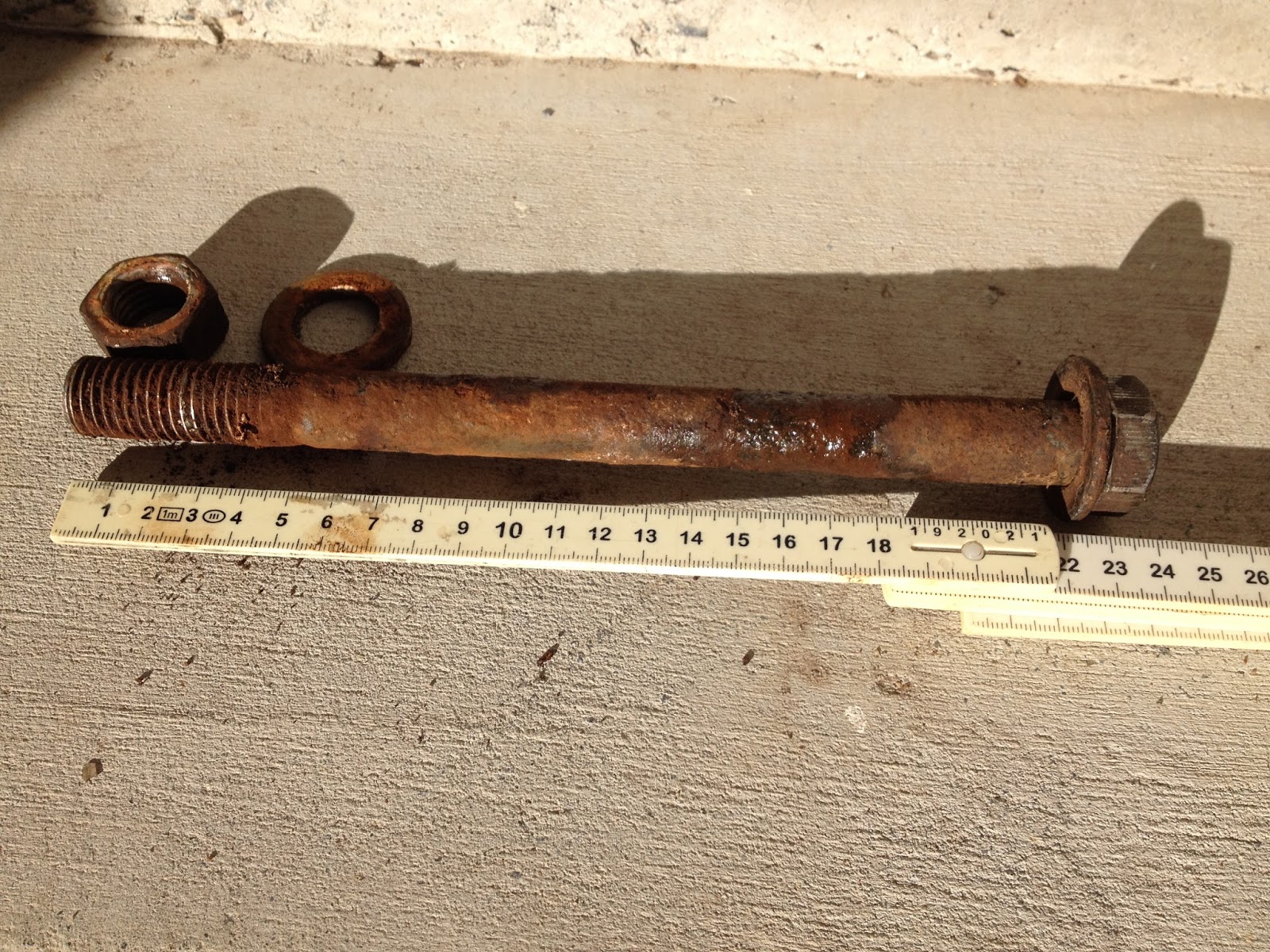
Austral 20 keel pin - 3/4" steel bolt


Austral 20 keel before removal
I tried hitting the keel with a hammer, but it didn't budge. I tried hitting it with a bigger hammer - a sledge hammer on loan from a friend - until a neighbour asked me to stop making a noise like I was hitting a massive metal plate with a massive hammer. I explained that that was exactly what I was doing, but I was getting nowhere and she had a point about the noise. So, I stopped and had a think. My wife wondered if I should take it to someone who knew what he was doing, but I decided to podger on.

There was something stopping the keel from dropping out of the bottom of the keel box. I decided the most likely culprit was rust. But, how could I get to it?

An alternative strategy to dropping the keel out of the bottom of the keel box was to lift it out of the top. There was the advantage that the top of the keel box was not as stiffly constructed as the bottom, so that lifting the keel would be undoing a wedge rather than tightening it. However, a full lift meant getting some (expensive) lifting gear inside the cabin and finding two points on the keel to safely attach to. I also needed to attach the lifting gear to something other than the GRP cabin roof. There was only one good point of attachment on the keel - the horn at the top of the keel to which the keel-raising line was attached via a shackle.

I struck upon a hybrid strategy - lift the top part of the keel out of the keel box and clean off the rust before dropping the whole thing through the bottom of the keel box. I found I could do this by using some scrap timber as a fulcrum and see-sawing the keel into position, locking it into place by using the boat's backstay to tie the top of the keel to the rear sliding beam in my carport. There was, fortuitously, a clear line of sight from the top of the keel, through the companionway to the beam. I also needed a few safeties to prevent the whole thing becoming a highly efficient guillotine at any of those critical moments when I had my body-parts in the direct line of swing.

Austral 20 - using the weight of the keel on a pivot to unlock the top part of the keel. To operate, pull the string...
After pulling the string ... the back goes down and the front goes up, unlocking it in the keel box. Jack up the back of the keel, relocate pivot further after aft and repeat ... until
... keel is fully dislocated but upright.

The final result got the top of the keel just clear of the top of the keel box, where I could get to the rust. As I suspected, there was plenty of rust on the sides of the keel, and it formed a number of "warts" on either side. I chipped away at the warts with a sacrificial wood chisel and attempted to saw off some of the rust-warts below the top of the keel box.

Austral 20 keel: top of keel levered out of top of keel box and suspended by rope attached to keel horn. Showing rust-warts on port side.
Austral 20 keel: top of keel levered out of top of keel box and suspended by rope attached to keel horn. Showing rust-warts on starboard side.

After chiselling the rust warts back as far as I could, I decided that, rather than lowering the keel gently down through the keel box, I'd cut the supporting rope and let it drop. I reasoned that I was substituting a 7 kg sledge-hammer with a 150 kg keel-hammer (it actually turned out to be heavier, as I'll describe later) to force it onto the ground. My first attempt failed. The keel got stuck in the keel box again. I had to lever it back into position, chip and scrape off more rust and try again. On the second attempt, the thing finally dropped clear of the boat and I gave a loud cheer. Actually, it was a rather muted cheer, because I'm English and have a very English sense of restraining one's emitions. It was if the boat had suffered a two year constipation, and I had got it to finally ... er ... deliver. The attached video shows this moment of triumph after five days' full-time travail. It might not be the most exciting video ever posted on the internet, but it was a mighty relief for me.


Looking back inside the now-empty keel box, I found that my earlier suspicions were correct. It was all about rust. Interestingly, the rust had formed rust-warts or nodes on the sides of the keel, and these had ground out grooves on the inside of the keel box. The tracking of the rust-warts in their grooves allowed the keel to pivot, but prevented it from dropping. There was nothing I could do about the grooves in the keel box, but I could get the rust-warts off the keel, and that is what I did next.
Austral 20 inside of keel box showing grooves ground into the sides of the keel box by rust warts on the keel. The grooves are a few millimetres deep and have worn through the white top layer into the clear GRP layer below.

Austral 20 inside of keel box showing grooves ground into the sides of the keel box by rust warts on the keel. The grooves are a few millimetres deep and have worn through the white top layer into the clear GRP layer below.

Episode 6 Finding the keel

The biggest problem facing me was having no idea of what I was looking for. All I knew was that the swing keel swung on a bolt (the keel pin) near the front of the keel box, and that it was becoming harder and harder to get it up and down.

Sensibly, you might suggest that I take a look at it, but taking a look was almost impossible. The keel was secreted in the sealed keel box with nothing but a small window at the front to show if it was up or down. When the keel was on the trailer, the under quarters of the trailer blocked the view from underneath; and when the keel was in the water it was, well, wet. Even if I had been game enough to go swimming under the boat (in the murky harbour among the Bull Sharks) I would not have seen much more than the edges of the keel. I even tried a borescope, but all that I could see was that the inside of the keelbox was narrow and filled with a large object that was, presumably, the keel.  I had to work with what I knew about the keel behaviour, and make some educated guesses, some of which, as I'll describe later, proved to be wrong.

Being over 30 years' old, the boat had no drawings and, so it seemed, no one alive who could remember how it was built. If you can imagine someone asking you what your spleen looks like, and you neither have access to Gray's Anatomy (or the TV series derivative) nor a desire to cut open your own belly with one of the knives in your kitchen drawer, you might sense the scope of my ignorance. It was like shooting in the dark with a gun that you'd only heard someone mention in a crime novel.

My wife, quite reasonably suggested that I take the boat to a boat mechanic. I decided it against it for a number of reasons, being

  1. I was out of work and had more time than money, and could not afford to pay someone else to do what I could do, even if I took four times as long;
  2. A boat mechanic would have to go through the same process of deduction to find what was there; and
  3. My belligerence, frankly, tempered by a more laudable curiosity to find out how the keel was constructed, what was going wrong with it and how it might be fixed.

But first, some history.

The keel had been getting harder and harder to lower and raise, and the problems started to manifest around January 2016. To start with, the no-name Chinese electric winch that winds in the cable that raises the keel seemed suspect, so I replaced it with a Ridge Ryder 1500lb (680kg) winch. That taught me about winches, but the keel still stuck.

I thought it might be the battery not giving enough "umph" to the electric winch, so I fitted a 20W solar panel on the rear handrail to trickle charge the battery between sailing trips, together with an Sunyo MPPT controller and an unfinished re-wiring project.  This rewiring project also needed a new bespoke fitted cabinet to house the new MPPT, switch panel, radios etc, which took several weeks to manufacture. This worked insofar as I grounded the boat whilst sailing around St Helena Island at low tide in February 2017, but all I needed to do was wind the keel up using my freshly charged battery, turn the boat around and sail off the sandbank that I had just hit.

Finally, in April 2017, the keel got itself well and truly stuck in the down position. Fortunately, my crew and I managed to drag the boat onto the concrete of the boat ramp, which must have pushed the keel partly up again, and then onto the trailer, so at least it was out of the water and ready to be transported somewhere for some attention. Also, we had just finished building a car port at home, which included some cleverly constructed sliding beams under the ceiling for the very purpose of hoisting the boat off the trailer for maintenance. I decided to seize the opportunity to un-seize the keel.

The first hurdle was getting into the keel box, which was harder than it should have been. Not knowing how the keel box was constructed, I thought it was a relatively simple case of getting the table off. The table is a plank of pine fixed to the top of the keelbox. Not only does it provide something to dine off, it stops any water in the keelbox from entering the cabin. Also, it serves as a horizontal prop between the compression post and the companionway bulkhead that helps to stop the keelbox from buckling under the load applied by the winch when it winds in the cable to raise the keel. Very clever.

What I did not realise was that the compression post sat directly on the top of the keelbox, and I ended up smashing the table to get it off. The engineer in me objects to breaking things in order to maintain them, but there you are. I thought the compression post passed through a hole in the keelbox onto a stainless steel plate (part of the sheave assembly) below, and all that was holding it in place was the excess from some liberally applied varnish and various layers of silicon and other goo smeared along the top of the keel box to seal it. By the time I had chiselled and cut and levered the table up, I realise that I had actually made the hole I thought was there and I had split the table along the grain, as the following photo shows. There was nothing for it but to take a saw to the remains and think about how to replace it all.

Austral 20 keel box from the starboard side. The table has been levered off keel box. The compression post is still in place, standing on a stainless steel plate that is part of the keel-lifting sheave assembly
Austral 20 keel box, from the front, with table partly removed and lodged part way up the compression post. The keel-lifting sheave assembly is at the front of the keel box, and the photo shows the upper plate and upper pulley wheel. The keel cable passes from a shackle on the top front of the keel, through two sheaves (pulley wheels) on the sheave assembly to the winch located towards the rear, behind the rear cabin bulkhead. The wood chips on the floor are the result of my exertions in getting the table up.

Austral 20 keel box with table fully removed, showing the compression post standing on the upper plate of the keel-lifting sheave assembly.
This destruction did give me my first look at the keel, or at least the trailing edge of it. I think the blue and brown colours are quite beautiful in the photo, but they spelled out one word loud and clear - rust. When steel rusts, it expands to about 18 times the volume of the parent metal. What I suspected was that the sides of the keel had rusted, and it was the expanded rust between the sides of the keel and the inside face of the keel box that was causing the keel to jam. It was a snug fit, though. You couldn't even get a sheet of paper between the sides of the keel and the keel box. There was only one solution - get the boat on the hoists and get the keel out.

Austral 20 swing keel in keel box, from above, showing signs of rust. The keel box is about 40mm wide and the keel fits snugly inside.

Episode 5 Uncle Podger

In considering new names, my wife has suggested Uncle Podger, after the hapless character in Jerome K Jerome's Three Men in a Boat. I have yet to determine if the new name is to apply to the boat, or to me.

She has also introduced a new word to the English Language - podgering - being the process of making something short and simple long and complicated. She texted me today to wish me well in my podgering, which I took to be a kind remark.

Fixing the keel over the course of several weeks might appear to be quintessentially podgerist, especially to an exasperated wife wanting the full and unhindered use of her new car port. This has been a long tale of attempting to fix one thing and finding half a dozen other things that need fixing first. In my defence, I should point out that I'd prefer to fix all those other things before I put the boat back together again, than to have to take it all apart again at an indeterminate date in the near future.

So, for instance, I asked the paint-shop to supply me with a small quantity of paint to make good a couple of nicks on my newly sand-blasted and recoated keel. The paint needed would have only covered the area of a small coin, but it was necessary to stop the seawater getting to the bare metal and thus initiating a repetition of the dreaded rusting. The paint shop kindly complied but the contingencies of the situation meant that the smallest quantity it could supply comprised a large dollop of bronze epoxy and about half again for the high gloss aliphatic polyurethane top coat, both with their respective hardeners. On hearing about the anti-rusting properties of the bronze epoxy, I seized the opportunity to apply the surplus to the under quarters of my rusting trailer.

This opportunity, however, came at the cost of additional work; the jacking and securing of the trailer at a safe height by shoring for working underneath; the removal of rust by means of a wire brush connected to my electric drill; the painting of the underside; top-coating with spray-on zinc; and removal of shoring, drop sheets and general mess, all of which took about three days.

At the end of Episode 4, I mused that I might rival Michelangelo in his painting of the Sistine Chapel. I believe I have managed to do so, but not in the way I had expected. Michelangelo painted the Sistine Chapel lying on his back, which is the same position I adopted in cleaning and painting my trailer. Except, that I had only a few inches between my nose and the rust flying off the wire brush, leaving me looking as if I had taken up a new career as a chimney-sweep. The aesthetic of my repainted trailer, alas, did not merit a comparison with the Sistine Chapel.

Kessner Tilt Trailer - Underside coated with bronze Intershield 300 by International Paints

The volume of the excess bronze epoxy also, sadly, did not cover the whole trailer, but there was sufficient to cover the areas most affected by rust.

Having de-rusted and re-coated the trailer, I went on to re-pack the Bearing Buddies. These are ingenious devices that use a spring-loaded piston to squeeze grease into the trailer bearings, thus squeezing water out. I had neglected them since they were installed two year's ago, and sensed that they needed some attention. I was not prepared for the gooey mess that ensued. Re-packing the Bearing Buddy requires the removal of a circlip (against which the spring pushes), removal of the piston, reloading the chamber with grease and replacement of the piston and circlip. The mess comes from getting the old blue-grease-rust-mud off the parts and spooning in the new red grease. There is a small hole in the Bearing Buddy that prevents a hydraulic lock, and which allows surplus grease to escape as you compress the spring and replace the circlip. The goo coming out of the hole was at first purple, then red. If it were any other colour, it could have been pigeon-poo.

Bearing Buddy without the plastic cap cover, showing circlip, spring and piston
Having repacked the Bearing Buddies, I then fixed up the mount for the board for the number plate and trailer lights. Previously, the board had been simply attached with pieces of rope, and I thought a more robust (and probably more legal) solution was in order. This was a simple matter of drilling some holes in the steel brackets at the back of the trailer, screwing a couple of pieces of treated pine from some offcuts, and drilling holes for a couple of stainless steel holding bolts with wing-nuts for easy removal. Simple, but another three hours.

Having remounted the number plate board, I decided to go to a weigh bridge to weigh the trailer, without the bunks and without the boat. I have already weighed the two bunks (8 kg each), and when I repeat the exercise with the boat on board, I'll know the weight of the boat. So, I towed it down to South East Queensland Hauliers in Hemmant, and paid $33 to find that the trailer weighs 0.36 tonnes, plus or minus 20kg. So, it could weigh anything between about 0.34 and 0.38 tonnes. Before I got upset about this lack of precision, I reminded myself that weigh bridges are designed to weigh multi-tonne trucks, to which 20kg is a mere trifle.

Having weighed and fixed the number plate board to my trailer, the next thing I did was to unintentionally reverse it into a concrete plinth, whereupon it bent. Thankfully, the damage was almost only cosmetic, and I decided I would not need a new number plate board quite yet.
Boat trailer light board - the unbent side.

None of this, I would argue on at least two counts, is podgering. The first count is that this is useful, if not time-consuming, work that will, hopefully, save me having to revisit it later on. The second count is that I have not commandeered the efforts of the whole household and my neighbours except as required, and only then on discrete occasions. Finally, I have not smashed my thumb with a hammer, though I have come close. I should admit to other mishaps that might qualify, such as getting grey paint on my knee and in the small of my back (the result of wiggling around under my trailer), or losing a drill bit because I was sitting on it.

I must admit to sharing an affinity with Uncle Podger, as he stood back and admired his workmanship. My keel is now back in the boat, and it goes up and down as intended. Small victories indeed.

**********************************************************************************************************
You never saw such a commotion up and down a house, in all your life, as when my Uncle Podger undertook to do a job. A picture would have come home from the frame-maker’s, and be standing in the dining-room, waiting to be put up; and Aunt Podger would ask what was to be done with it, and Uncle Podger would say;
“Oh, you leave that to me. Don’t you, any of you, worry yourselves about that. I’ll do all that.”
And then he would take off his coat, and begin. He would send the girl out for a sixpen’orth of nails, and then one of the boys after her to tell her what size to get; and from that, he would gradually work down and start the whole house.
“Now, you go get me my hammer, Will,” he would shout; “and you bring me the rule, Tom; and I shall want the step-ladder, and I had better have a kitchen chair, too; and, Jim! You run round to Mr. Goggles, and tell him, ‘Pa’s kind regards, and hopes his leg’s better; and will he lend him his spirit level?’ And don’t you go, Maria, because I shall want somebody to hold me the light; and when the girl comes back, she must go out again for a bit of picture-cord; and Tom! – where’s Tom? – Tom, you come here; I shall want you to hand me up the picture.” 
And then he would lift up the picture, and drop it, and it would come out of the frame, and he would try to save the glass, and cut himself; and then he would spring round the room, looking for his handkerchief. He could not find his handkerchief, because it was in the pocket of the coat he had taken off, and he did not know where he had put the coat, and all the house had to leave off looking for his tools, and start looking for his coat; while he would dance round and hinder them. 
“Doesn’t anybody in the whole house know where my coat is? I never came across such a set in my whole life – upon my word I didn’t. Six of you! – and you can’t find a coat that I put down not five minutes ago! Well, of all the –“ 
Then he’d get up, and find that he had been sitting on it, and would call out: 
“Oh, you can give up! I’ve found it myself now. Might just as well ask the cat to find anything as expect you people to find it.” 
And when half an hour had been spent in tying up his finger, and a new glass had been got, and the tools, and the ladder, and the chair and the candle had been brought, he would have another go, the whole family, including the girl and the charwoman, standing round in a semi-circle, ready to help. Two people would have to hold the chair, and a third would help him up on it, and hold him there, and a fourth would hand him a nail, and a fifth would pass him the hammer, and he would take hold of the nail, and drop it. 
“There!” he would say in an injured tone, “now the nail’s gone.”
And we would all have to go down on our knees and grovel for it, while he would stand on the chair and grunt, and want to know if he was to be kept there all evening. 
The nail would be found at last, but by that time he would have lost the hammer. 
“Where’s the hammer? What did I do with the hammer? Great heavens! Seven of you, gaping round there, and you don’t know what I did with the hammer!” 
We would find the hammer for him, and then he would have lost sight of the mark he had made on the wall, where the nail was to go in, and each of us had to get up on the chair, beside him, and see if we could find it; and we would each discover it in a different place, and he would call us all fools, one after another, and tell us to get down. And  he would take the rule, and re-measure, and find that he wanted half thirty-one and three-eights inches from the corner and would try to do it in his head, and go mad. 
And we would try to do it in our heads, and all arrive at different results, and sneer at one another. And in the general row, the original number would be forgotten, and Uncle Podger would have to measure it off again. 
He would use a bit of string this time, and at the critical moment, when the old fool was leaning over the chair at an angle of forty-five, and trying to reach a point three inches beyond what was impossible for him to reach, the string would slip, and down he would slide on to the piano, a really fine musical effect being produced by the suddenness with which his head and body struck all the notes at the same time. 
And Aunt Maria would say that she would not allow the children to stand round and hear such language. 
At last, Uncle Podger would get the spot fixed again, and put the point of the nail on it with his left hand, and take the hammer in his right hand. And, with the first blow, he would smash his thumb, and drop the hammer, with a yell, on somebody’s toes. 
Aunt Maria would mildly observe that, next time Uncle Podger was going to hammer a nail into the wall, she hoped he’d let her know in time, so that she could make arrangements to go and spend a week with her mother while it was being done. 
“Oh! You women make such a fuss over everything,” Uncle Podger would reply, picking himself up. “Why, I like doing a little job of this sort.” 
And then he would have another try, and, at the second blow, the nail would go clean through the plaster, and half the hammer after it, and Uncle Podger be precipitated against the wall with force nearly sufficient to flatten his nose. 
Then we had to find the rule, and the string again, and a new hole was made; and, about midnight, the picture would be up – very crooked and insecure, the wall for yards round looking as if it had been smoothed by a rake, and everybody dead beat and wretched – except Uncle Podger. 
“There you are,” he would say, stepping heavily off the chair on to the charwoman’s corns, and surveying the mess he had made with evident pride. “Why, some people would have a man in to do a little thing like that!”
Jerome K Jerome, Three Men in a Boat, 1889

Episode 4 Rope and other foreign languages

You can never have enough rope. Except when you have too much.

That's the kind of advice you get when you're a novice, and you only find out how useless it is when you're standing in a chandler's, bewildered by the choice of rope on offer and trying not to look embarrassed in front of a friendly, but knowledgeable, sales assistant.

My introduction to buying rope came about when I learned the hard way that my mooring lines (the ropes that tie the boat to the wharf or pontoon) were too short. It's not a nice feeling trying to stop the boat wandering off on its own, when you're on tiptoes, teetering on the edge of dry land with the last two inches of rope in one hand, the other extended behind you as a counter-balance. Or, you need to swing the stern around to line up the boat on the trailer, only to find that the only way to do it is waist deep down the ramp, standing on the slippery algae that populates concrete ramps at a depth corresponding to your waist-height below water.

So, I bought some more mooring lines. Going from a rule-of-thumb that says your mooring lines should be about the length of the boat, I got three lines at 6 metres and one at 10 metres (to swing the stern from a drier, firmer position on the boat ramp). However, I got bamboozled by the figure-of-eight knots needed to tie the lines to the cleats on the boat, which consumed a good metre of line each.

So, I tried again, but forgot to take note of the rope diameter, and unintentionally upsized from 10mm to 12mm. You might think that this change might be insignificant or even desirable, but the fatter rope needed yet more length for the knots, and it became almost too big to push through the cleats. I'm beginning to appreciate the necessity of measuring things before heading off to the shops.

You might be forgiven for thinking that my boat now has plenty of ropes, but you'd be mistaken.

A trick question that I ask kids when sailing with them with Sails at Bayside, or on my own boat is how many ropes are there on this boat? Some make a guess, others get industrious by counting them, but the only ones who get it right are those who heed my warning of it being a trick question. The answer is, in fact, none. There would be one if I had a ship's bell, which would be rung by the only thing called a rope on board - the bell rope.

A mysterious metamorphosis between the chandlery and the boat changes the ropes into something else - something more nautical-sounding. Thus, a boat will have stays, shrouds, sheets, halyards, lines, hauls, but never a rope (without the bell). The most probable explanation is that the "rope" ceases to be purposeless commodity and takes on the name of what it has been assigned to do. Nautical language, however, pre-dates modern English, and you sometimes have to slip back a few centuries to make the connection between name and function.

Stays are probably the easiest. In a Bermuda-rig like mine, the single mast will have a forestay and a backstay, and they keep the mast staying upright. They also belong to the class of rigging known as standing rigging, possibly because without it, the mast will succumb to gravity and fall down. Also, its not generally adjustable when underway but, in one of those ironies that get in the way whenever you think life is just about to get simple, backstays on fractional rigs are adjustable. They are used to flatten the mainsail for better efficiency in stronger winds. A fractional rig has the forestay connected to the mast 7/8 or 3/4 up the mast (hence the name). The offset between the connection to the forestay and the backstay allows the sailor to bend the mast by tightening the backstay, which flattens the sail. When I first heard of this I thought it was the other way round - the more bend in the mast, the more "baggy" the sail. I had not appreciated that sails are not flat pieces of material like a bedsheet, but are constructed with a belly in them, which becomes more pronounced when the leading edge (the luff) is bent by the mast.

Boats, especially sailing boats, are complicated machines. I liken sailing to flying with a vertical wing, and its one of the reasons I find it so fascinating. However, learning to sail comes with learning an entirely new language.

Anyhow, my boat is a mast-head rig which, as you might infer from the name, means that everything runs up to the top of the mast. This gives me a bigger foresail than a fractional rig, but less capability to adjust the shape of the mainsail. My backstay is more about anchoring the mast in position, than bending it. Indeed, my boat also has a baby-stay, which runs from the foredeck to the spreaders, and is intended to support the mast rigidly from being bent. The result is that the Austral 20 is very stiff, and that makes it an excellent learner boat.

The word "shroud" is actually related to our word for burial clothing (e.g. The Turin Shroud), according to my Chambers Dictionary of Etymology;
The meaning of the shroud, usually shrouds, any of the ropes supporting the mast or masts of a ship, is sometimes treated as a separate term in standard dictionaries, but the development of this meaning seems a natural extension of the idea of clothe as supported by the use of the nautical phrase clothe the mast with shrouds and the application of the word naked to a mast or spar without its rigging ... The same sense of development appears in Old Icelandic ... Probably before 1350 schruden to dress, clothe; later to cover, veil ... from the noun.

Later, I'll get to the running rigging named, or so I think, after what you do around on deck as you try to get your boat heading in the right direction.


Austral 20 Standing Rigging

PS The picture this week was produced from my first attempt at producing sketches using Gimp. I'm rather pleased with it, though the result is rather crayon-ish. Tomorrow, I intend to rival Michelangelo's frescos in the Sistine Chapel with my new-found skill. How difficult could it be?

PPS After posting this, some smart person pointed out that the boat might have a bolt rope. Technically, my boat does not have one, but the catamarans I sail for Sails at Bayside do. I'd call that a draw.

Episode 53 Corner Blocks

 This was probably the most complex piece of wood-working I have carried out on my Cygnet 20. I had previously made up some corner-blocks, w...